

Why the US needs an AI productivity boom
Without it, slowing labor force growth may dampen future economic growth
5 min read
KEY POINTS
- Strong corporate earnings and ongoing investment in AI are supporting economic momentum despite geopolitical uncertainty.
- Slowing labor force growth, driven by aging demographics and more restrictive immigration, poses a growing challenge to future expansion.
- AI-led A potential surge in productivity could be critical to sustaining growth and easing fiscal pressures in the years ahead.
Hopes for an agreement to end the conflict in Iran have been a welcome source of relief within the capital markets, even as uncertainty about major areas of disagreement remain. Still, despite the conflict, corporate earnings have been spectacular to begin the year and estimates for 2026 and 2027 continue to ratchet higher. The artificial intelligence (AI) capex-driven investment boom shows little signs of abating, and we see trends within the broader economy of improvement as well.
Looking past the conflict in Iran, the U.S. economy’s continued ability to grow rests on two primary pillars, the size of the labor force and productivity improvements. Our charts this week show improvements in productivity while the growth in our labor force is becoming a headwind to growth. The top chart shows the combination of the two over various periods in the past. The bottom chart is a bar graph of productivity growth by year back to 2010.
Productivity growth is important for our economy to grow while keeping inflation at bay. What we can also see in both charts, however, is that productivity growth is more cyclical than changes in the labor force. This makes sense as technological advances—such as the development of computers, smartphones, the internet and AI— do not happen in smooth progression. Instead, we see productivity surge at times and slow at others.
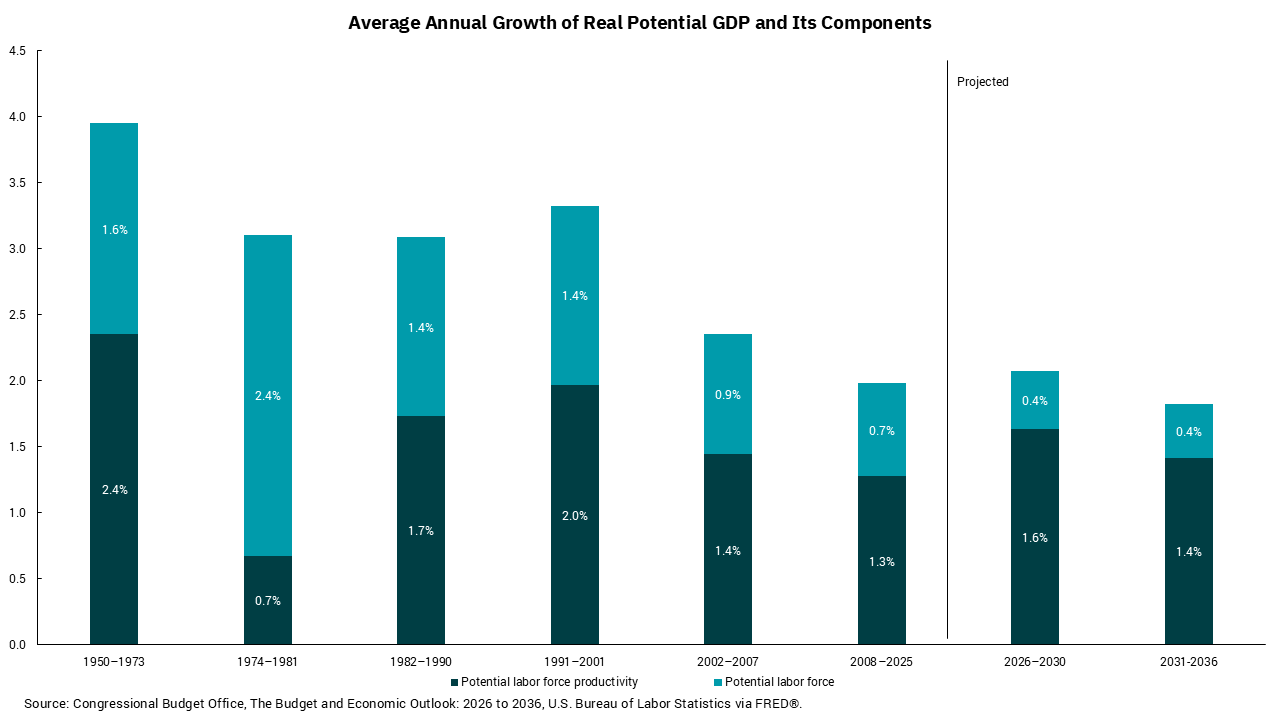
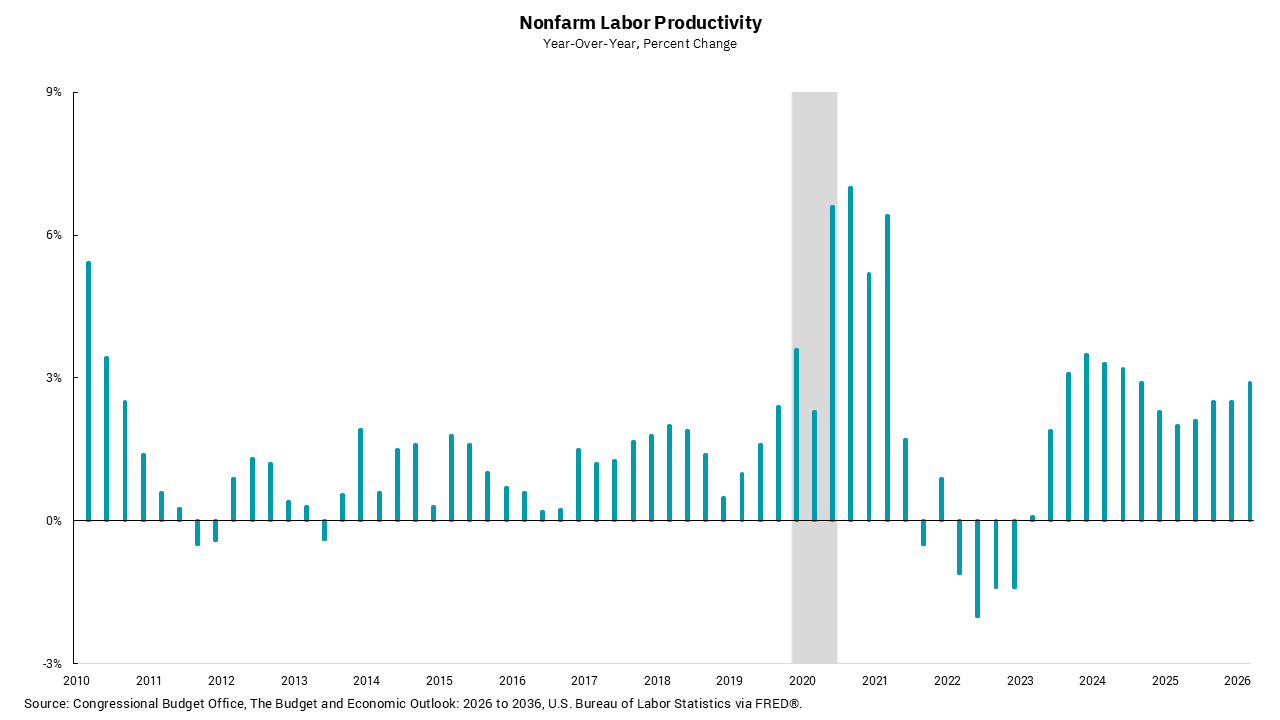
Our overall sense is that the rise of AI will provide an opportunity for a generational-type increase in productivity. While there may be some negative implications to this shift as companies re-allocate resources away from labor to technology, the realities of our labor force may mean we are going to need every bit of the promised productivity to come to fruition. The top chart shows clearly the smaller part labor force growth is expected to play versus productivity growth as compared to past periods.
We have two headwinds to labor force growth, the longer term and more stable source of an increase in potential output, working at once. Our organic demographics show we are an aging population. The number of 65-year-olds as a percentage of our population is growing, while the number of 17-year-olds is declining. This harbors an outlook for a declining prime-age labor force over the next few years. At the same time, immigration policies have become more restrictive and could slow the growth of the work force from that perspective. Few would argue that we need the right kind of immigration policy, and this area of policy represents a huge challenge and a huge opportunity.
The need for growth going forward is absolutely vital. Our fiscal position is one which will be much easier to handle if we can grow our economy. Trying to reduce deficits with a combination of spending cuts and revenue increase will be painful for everyone. Polices that can lead to growth are a better option. AI holds a lot of promise on the productivity side; let’s hope our leaders can get together to improve the outlook on the labor force side. We all stand to benefit when they do.
Get By the Numbers delivered to your inbox.
Subscribe (Opens in a new tab)